


All about Rocket science
Rocket science refers to the study and application of rocket propulsion technology. It involves the design, construction, and operation of rockets, as well as the development of technologies and systems to support space exploration and travel. Rocket science has played a critical role in advancing human knowledge, enabling space exploration, and expanding our understanding of the universe.
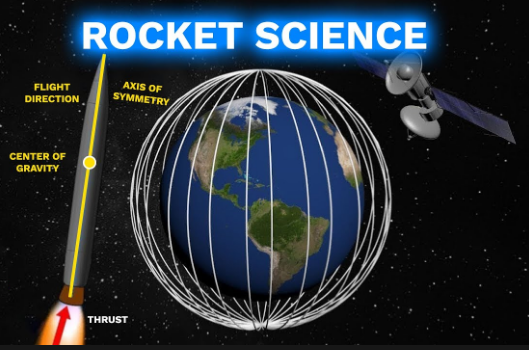
The foundation of rocket science is Newton’s third law of motion, which states that for every action, there is an equal and opposite reaction. This law provides the basis for understanding how rockets generate thrust, which propels them forward. Rocket engines work by expelling a stream of high-velocity gas out of the back of the rocket, which creates an equal and opposite force that propels the rocket forward.
There are many different types of rocket engines, each with its own unique characteristics and applications. Some of the most common types of rocket engines include liquid-propellant engines, solid-propellant engines, hybrid engines, and ion engines. Liquid-propellant engines are the most common type of rocket engine and use liquid fuel and oxidizer that are mixed and burned in a combustion chamber. Solid-propellant engines, on the other hand, use a solid fuel that is burned to generate thrust. Hybrid engines use a combination of liquid and solid fuel, while ion engines use electric fields to accelerate charged particles and generate thrust.
Rocket science is a highly interdisciplinary field that draws on knowledge and expertise from many different areas of science and engineering. In addition to propulsion technology, rocket science involves the design and construction of rocket structures, guidance and control systems, life support systems, and other critical components that are necessary for successful space travel.
One of the most important applications of rocket science is space exploration. Rockets have been used to launch satellites into orbit, explore our solar system, and even send humans to the moon. The development of rocket technology has enabled us to study the cosmos in ways that would have been impossible just a few decades ago.
Rocket science has also played a critical role in national security and defense. Rockets can be used to deliver military payloads, launch reconnaissance satellites, and provide early warning of missile attacks. The ability to develop and deploy advanced rocket technologies is a key component of modern military strategy and has helped to ensure the security and stability of nations around the world.
In addition to its practical applications, rocket science has also inspired countless works of science fiction and has captured the imagination of people all over the world. From the classic science fiction novels of Jules Verne to the modern blockbuster movies like Star Wars and Star Trek, rocket science has been a source of inspiration and wonder for generations.
In conclusion, rocket science is a complex and interdisciplinary field that plays a critical role in enabling space exploration, advancing human knowledge, and ensuring national security. With ongoing advances in rocket technology, it is likely that we will continue to make new discoveries and push the boundaries of what is possible in space exploration and travel.
Application of rocket science
Rocket science has numerous practical applications in fields such as space exploration, national defense, scientific research, and commercial space industry. Some of the most significant applications of rocket science are as follows:
- Space exploration: Rockets are crucial for launching spacecraft into orbit and beyond. Rockets have been used to launch satellites, probes, and rovers that have explored our solar system, including the Moon, Mars, and other planets. Rockets are also essential for transporting astronauts to and from space, and for building and servicing space stations.
- National defense: Rockets have played a vital role in national defense by providing the ability to launch military payloads and reconnaissance satellites into orbit. Rockets are also used for ballistic missile defense and early warning systems.
- Scientific research: Rockets have been instrumental in advancing scientific research by allowing scientists to conduct experiments and observations in space. For example, rockets have been used to study the atmosphere, climate change, and the behavior of particles in zero-gravity environments.
- Commercial space industry: Rocket technology has enabled the emergence of a commercial space industry that is focused on launching satellites, providing space tourism, and mining resources from asteroids and other celestial bodies.
- Communications: Rockets have played a crucial role in the development of modern communication systems by launching communication satellites into orbit. These satellites allow for the transmission of data, television signals, and telephone calls across vast distances.
- Medical research: Rockets have also been used in medical research to study the effects of zero-gravity environments on the human body. This research has helped to advance our understanding of human physiology and has contributed to the development of treatments for conditions such as osteoporosis.
- Environmental monitoring: Rockets have been used to launch satellites that can monitor and map the Earth’s environment, including the atmosphere, oceans, and land. This information is essential for understanding and addressing environmental issues such as climate change and natural disasters.
In conclusion, rocket science has a wide range of practical applications that are essential for advancing our knowledge, exploring the universe, and improving our lives on Earth. With ongoing advancements in rocket technology, it is likely that we will continue to see new and innovative applications of this field in the years to come.
Rocket science examples
Rocket science is a complex and interdisciplinary field that has led to many significant discoveries and advancements in science, technology, and engineering. Here are a few examples of some of the most notable applications of rocket science:
- The Apollo Moon landing missions: The Apollo program, which was launched by NASA in the 1960s, aimed to send astronauts to the Moon and bring them back safely to Earth. This mission involved developing and launching powerful rockets, such as the Saturn V rocket, which remains the most powerful rocket ever built. The successful Apollo missions paved the way for further space exploration and contributed to our understanding of the Moon and its formation.
- The Space Shuttle program: The Space Shuttle program, which ran from 1981 to 2011, involved the development and use of reusable spacecraft that could carry astronauts and cargo into orbit. The Space Shuttle program required significant advancements in rocket technology, including the development of powerful engines and solid rocket boosters. The Space Shuttle program allowed for the construction of the International Space Station and the deployment of numerous scientific instruments and satellites.
- Mars Exploration Rover: The Mars Exploration Rover (MER) mission, launched by NASA in 2003, involved sending two rovers, Spirit and Opportunity, to Mars to study its geology and search for evidence of past water on the planet. The MER mission involved developing advanced rocket technology to launch the rovers into space and then land them safely on the Martian surface. The success of the MER mission paved the way for further exploration of Mars, including the ongoing Mars rover missions.
- Commercial space industry: The development of the commercial space industry, which involves launching satellites, providing space tourism, and developing new technologies, has been made possible by advances in rocket technology. Companies such as SpaceX and Blue Origin have developed reusable rockets and spacecraft that are lowering the cost of accessing space and enabling new applications such as space tourism and the exploration of resources on other planets.
- Weather satellites: The development and launch of weather satellites, such as the Geostationary Operational Environmental Satellite (GOES), have revolutionized weather forecasting and disaster response. Weather satellites use advanced rocket technology to be launched into orbit and provide crucial information on weather patterns, natural disasters, and climate change.
In conclusion, rocket science has led to many significant advancements in space exploration, scientific research, and commercial applications. The examples above demonstrate the incredible potential of rocket technology to expand our knowledge and improve our lives on Earth and beyond.


